
Author: Dr. Zach Cullen
One of the most common complaints that I treat when working with MMA fighters, Grapplers, and Martial Artists is the infamous ongoing strain and discomfort involving the neck. Through first hand experience, I have felt that the demand placed upon the neck. Whether you are fighting off a guillotine, a rear naked choke, resisting being snapped down in the clinch, using your head to drive an opponent down with single/double leg takedowns, keeping your head off the mat while in multiple guard variations, or inverting onto the back of your spine when entering in various leg entanglements, the reality is that grappling takes a huge toll on the neck. Much of this stress is unavoidable if you are training in a combat sport. Through my trials and tribulations, I have come to learn that there are a few boxes you want to check off to make sure that you are able to have the resiliency in your neck to be able to recover and keep training consistently without getting side lined with repetitive injuries.
Step 1: Improve breathing mechanics:
In an older post I wrote titled Belly Breathing Vs. Chest Breathing I go into great detail on how chest breathing can place a significant impact on the musculature of the neck and lead to overuse of the scalanes, SCM, superior intercostal muscles, and the pecs. This is due to chest breathing facilitating an elevation of the top of the ribcage that places a huge demand on the neck just to maintain respiration.
In my experience, many combat athletes struggle to offload the neck and shoulders to breathe. I suspect this is due to the high stress environment that training combat sports places on the nervous system which biases the breathing into a more chest dominant pattern. This may be due to sympathetic nervous system upregulation. Chest dominant breathing also can lead to tightening on the neck and shoulder muscles which can alter postural stabilization within the neck and shoulders. This can often lead to a viscous cycle of tension and pain within the neck.
Step 2: Improve segmental control and mobility of the spine globally:
Another common problem I observe amongst combat athletes is that the neck simply has to do more because other parts of the spine are not doing their fair share. More specifically, I commonly notice that many combat athletes have difficulty with controlling and accessing extension/rotation through their thoracic spine. I believe this to be attributed to the typical postures associated with fighters and grapplers and also the sport specific adaptations to maintain rigidity within the spine isometrically when closing distance and entering connection with your opponent.
In wrestling and BJJ specifically the posture very commonly taken is one in which the body is in a slight forward bend (mostly due to flexing of the thoracic spine) with your shoulders tucked in to defend underhooks/arm drags/russian ties/etc. with the head positioned straight forward (neck in a high degree of extension) to keep your gaze upon your opponent. This posture can also be seen in MMA when going for a take down and keeping head position properly to improve your control of the opponent.
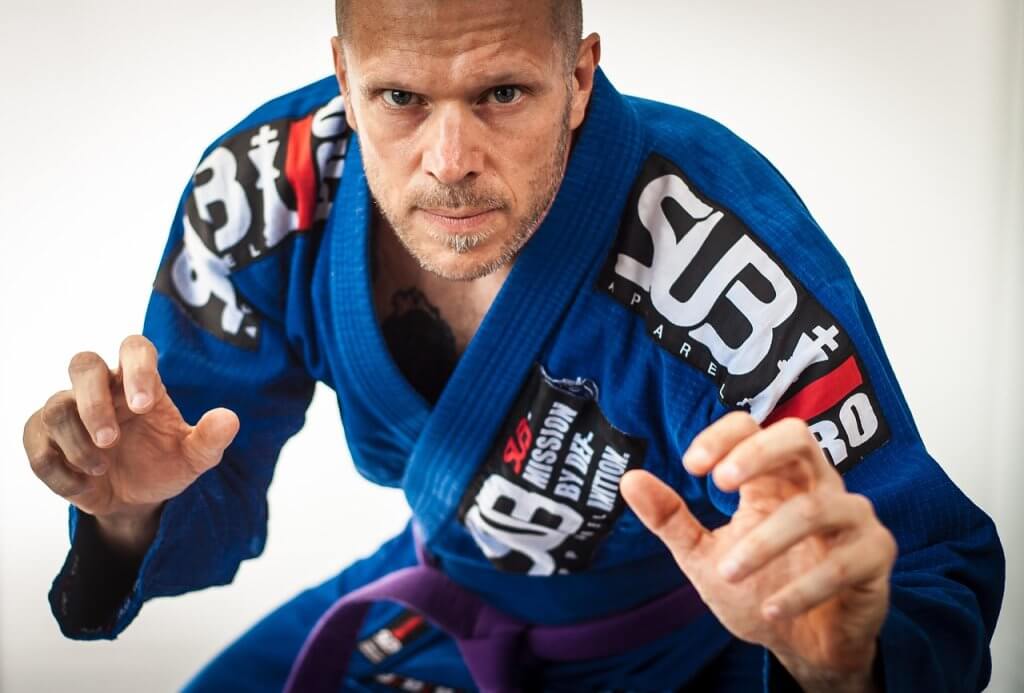
Due to common sport specific adaptations to the stability and mobility of the spine, the upper neck commonly gets locked into extension and the thoracic spine loses the ability to extend, straighten, and rotate properly. Maintaining the crouched position can also tighten the hip flexors (which also can happen with throwing/chambering/checking kicks as well as retaining various guard positions) which secondarily reduces the lumbar spine’s ability to round into flexion properly.
Whew…That was a lot I know.
To simplify how to fix this we need to improve deep neck flexor strength to improve strength equality within the neck, Improve thoracic extension/rotation mobility, and improve spinal/pelvic flexion mobility/stability. This global improvement in control, stability, strength, and mobility within the spine will help to offload the neck’s need to do more work than it should in any given movement scenario. This will also help to ensure that we maintain balance within the body as to not train our body into only being able to access a limited amount of movement.
Just to clarify: I am not suggesting that you do not perform your techniques the way that you currently are. Many of the positions and techniques have a specific purpose and are optimal for your performance in the sport. I am simply suggesting that if you do not ensure equality of movement that you are significantly more likely to experience pain.
Step 3: Improving shoulder/scapular mobility, stability, and strength
The postural stress imposed upon the body when performing combat sports does not only have biases within the spine but also the shoulders and shoulder blades.
Excessive rounding is observed within the thoracic spine, and the compensatory excessive extension within the neck and low back. What also is commonly noticed is the rounding forward of the shoulders and shoulder blades. This highlights the relationship between how the imbalance of strength and mobility through the front of the torso can affect the postural position of the spine
While this posture is not inherently bad it certainly can be suggestive of a problem if the individual is feeling pain within their neck/upper back and also struggles to access strength and range of motion in the opposite direction within their body.
Correcting this usually involves some variation of strengthening the anterior torso musculature from an overhead position with an emphasis on the deep stretch. This will not only improve flexibility but help to retain access to that range of motion by promoting strength and coordination adaptations. Alongside this will be some variation of exercises that focus on strengthening the shoulder blades, posterior shoulder, and upper back with an emphasis on peak contractions from the shortened position.
If you are a combat athlete you are almost guaranteed to have some sort of neck pain or injury come up during your participation in the sport. The reality is that grappling and striking just takes a toll on the neck. The goal here is not to never feel pain in your neck but rather to improve the resiliency of the neck itself as well as the surrounding body parts.
This will help to reduce the intensity and duration of impact of neck pain when it inevitably arises. If you are a combat athlete suffering from neck pain, Move Better is here to help you get back to training as soon as possible!
CONTACT US »